

Editor Insights: Hinterland
Q&A with Andrew Kenrick, Founder and Editor-in-Chief; Freya Dean, Founder and Associate Editor; and Yin F Lim, Associate Editor


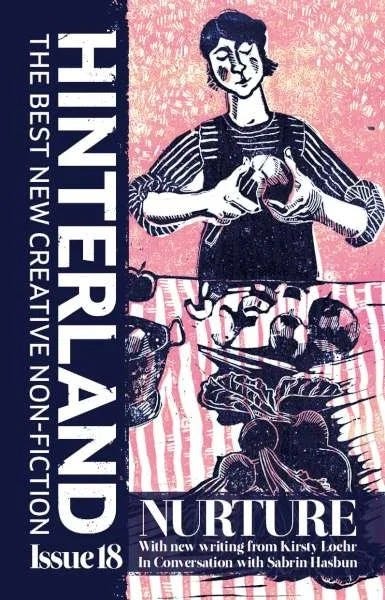
This week, we’re chatting with three editors from Hinterland, a UK-based print and digital magazine dedicated to creative non-fiction. They are especially interested in publishing new voices and work that sits outside the usual categories, as long as it “falls somewhere in the realm of non-fiction writing.”
Andrew Kenrick, founder and editor-in-chief, is a writer, editor, and lecturer in creative writing and publishing. He holds a PhD in Life Writing from the University of East Anglia. His first book, Rex Juba: 15 Glimpses of an African King, is out this week from Penguin Random House.
Freya Dean, associate editor/founding editor, is of Dutch-British descent. She graduated from the University of East Anglia’s Creative Writing MA, where she received the Lorna Sage award and, the same year, was an Elizabeth Kostova Foundation Finalist. Recent work features in The Real Story, Visual Verse, and UEA’s anthology series.
Yin F Lim, associate editor, completed an MA in Creative Non-Fiction at the University of East Anglia and mainly writes about family, food and migration. She is the winner of the Mo Siewcharran Prize 2025 for her work-in-progress about her maternal grandmother’s emigration from Southern China to British Malaya in the early 20th century.
Q&A with Andrew, Freya, and Yin
How did Hinterland come to be, and why did you decide to focus exclusively on creative non-fiction?
Andrew: My co-founder Freya and I started Hinterland at the end of 2018. We’d met studying in the University of East Anglia’s MA in Creative Non-Fiction and were both getting frustrated by the lack of outlets to submit our non-fiction to (especially outlets that paid to publish). Before we returned to our studies, we’d both worked as editors for magazines, so we thought we’d put our money where our mouth was and found our own. The irony, of course, is that once you’re the editor of a magazine, it’s generally considered poor form to publish your own pieces, so our problem remained! (We have both since been strong-armed by the rest of the editorial team into publishing our own work…) Nearly 8 years on, we’ve just published Issue 18. The team’s a good deal bigger now too, first adding Yin, and more recently, Iona Macduff, as co-editors.
Freya: There was even a particular lightbulb moment, as I recall it, when Andrew and I had attended a session where leading publishers and agents came to visit our cohort and those from the Prose Fiction MA. They were so clearly open to short-form work from the fiction writers, but not one of the agents or publishers was able to respond meaningfully to our questions about how to get our short-form creative non-fiction out into the world. It was as if they didn’t know what to do with new writers working in that field. Whereas we could see exactly what the problem was and how to solve it!
What are you looking for in submissions? What excites you most when you read a piece of work?
Yin: Something that keeps me thinking long after I have finished reading it, whether it’s a strong voice, a particular resonance, or a narrative or story that feels fresh, offering a perspective that may not have been explored before. What excites me most is discovering a shift in my own thinking as a result of reading a great piece of creative non-fiction.
Andrew: I love it when I glance at a submission with the intent of coming back to read it properly later, and find myself reading it in one sitting then and there. I love non-fiction with a real sense of story, a narrative drive that just compels me to keep reading.
Freya: I’d say we are also—almost uniquely within the publishing world—open to pieces that are impossible to define, or to put a label to. We’ve published work that meanders mid-piece into a poetry form, work that required paragraphs of blank space as part of the power of the writing (I recall that driving our art director slightly crazy when he came to do the layout!), another where the story happened as much in the footnotes as in the main body of text. I think because of the control we have, we can be really brave about what we choose to publish and that is a strong point of difference for us.
What are you not looking for in submissions?
Andrew: There are all sorts of things we’re not looking for – for example, we don’t publish reviews, more conventional journalism, or straight-up academic writing. We also strive to be timeless, so a story that is particularly time-sensitive or about now might not be a good fit for us.
Freya: I am immediately put off by anything overtly sentimental or mawkish, which can be an easy pitfall for writers of non-fiction, especially when dealing with something really personal or family-related.
What are some common reasons submissions are rejected?
Andrew: This one might be obvious, but not reading the submission guidelines! The most egregious of these errors tends to be submitting pieces that are much too long (5,000 words is our maximum, and this does tend to be a hard limit no matter how good your piece is).
Freya: It also frustrates me when submissions come in that are so clearly long-form, but they have been submitted to our flash category. Read the rules!
How do you use the cover letter/bio?
Andrew: To be honest, the cover letter/bio doesn’t factor in at all for me. I like to read the submission first, so by the time I get to the cover letter, I’ve already made up my mind whether I like the writing or not.
Yin: I sometimes scan the cover letter when I open a submission, but like Andrew, I’m more interested in the actual work itself and whether or not it grabs my attention and stays with me.
When it comes to deciding on submissions, we assess the writing and the work, not the writer’s credentials or even their passion for the subject matter. Do bear in mind that we publish work from both new and established writers, and I personally get a thrill from discovering a great piece of work that could be someone’s first publication!
That said, I always appreciate it when writers note in the cover letter that they’ve taken the time to read the magazine and get to know the work we publish.
What is the average number of submissions you receive during a submission period?
Andrew: It can vary but is often quite a lot! Anywhere from 100 to 300 submissions, and the general quality is very high. We tend to accept 10 to 12 pieces from each submission period for the new issue, which sadly means rejecting a lot of very good pieces. As a guide, we say we make a decision on submissions within 6 months, but this can be longer. Our team of readers is all volunteers, so it can take more or less time depending on what else is going on!
Do you have any submission pet peeves that writers should avoid?
Yin: Single spacing! In our submission guidelines, we ask writers to please use a legible font and double-spacing, as this makes for an easier reading experience when we’re dealing with a huge volume of work. Yet we still receive many pieces that disregard this. Whenever I come across a piece that’s single-spaced, I’m inclined to reject it, but because we try to read each submission, I will give it a go, although I won’t be in the best mood to appreciate the work. Make our lives as editors and readers easier; it will make us more amenable to your work!
Freya: Increasingly, I’ve also noticed a glut of pieces that still contain the visible edits and suggestion boxes. This makes it feel as if we are receiving a piece that isn’t quite finished. I always read these pieces in full, but it doesn’t inspire confidence!
Are there any topics that feel overwritten about?
Andrew: I’m going to preface my answer by saying that we’re all huge fans and readers of memoir, but we get a LOT of memoir submitted to us. By a wide margin it is the genre we receive the most of. We will always have a place for good memoir pieces—the majority of our content is memoir—but it has to be exceptional to get published.
Yin: I second that. We get so much memoir, and because it’s so personal, some submissions can read quite raw, with the emotions still close to the surface. The work really needs to stand out for us to consider it for publication, and the most exquisitely crafted memoir pieces are usually the ones written from a certain level of distance or detachment.
Are there any topics that you wish you saw more of?
Andrew: I’d love to see more popular science, more sports writing, more biography, and more narrative history. I may be biased on that last point, as a writer of narrative history myself. It’s curious though, given what percentage of a bookshop is made up of these genres, how little of it we get sent. Definitely a surefire way to get noticed by our editors though…
Yin: I’d love to see more new journalism/literary journalism, and work that is playful and experimental, pushing the boundaries between non-fiction and fiction. I’d also love to see more submissions with perspectives beyond the mainstream or default; those that reflect the rich experiences and stories of the diverse societies and communities we live in.
Freya: For me, the overlaps between poetry and non-fiction are so clear that I’m always ready to see work that tips towards prose poetry in terms of form. We do see pieces like this, usually in our flash submissions, but I’d love to get more of it. So, if you’re someone who currently sends work only to poetry journals and magazines, consider sending some our way!
What does the reading/review process look like behind the scenes once a submission comes in?
Andrew: We’ve got a team of a half a dozen or so readers who, alongside me and the associate editors, read through the submissions in Submittable. Every piece that is submitted is typically read by at least a couple of members of the team, in full, and then a one-line comment is made along with a crude thumbs up/thumbs down reaction. Usually a piece requires two thumbs up to get on our longlist, or else have a passionate advocate on the team. We then look at the longlist and see if a theme is emerging organically, which might then prompt us to reopen submissions along those lines or focus on the pieces that fit the theme. We’ll then whittle it down to a shortlist, at which point the associate editors and I will see which pieces we feel most strongly about, and how many of those we can fit into the issue. This is always the most painful part of the process, as it ultimately means declining pieces that are exceptionally good.
Freya: I think it’s worth stressing Andrew’s point above about how carefully and widely each piece we receive is read. When Andrew and I started Hinterland, we were very aware that everyone, including us, has a particular eye and ear for what we like, so we have always been very cautious not to disregard a piece following one person’s read. Every submission gets at least two people’s time on it. And I think that’s rare, and of huge benefit for writers submitting to us. And occasionally, we do publish pieces that we haven’t felt unanimously about, which speaks to how much we trust each other’s judgement.
Do you ever work with writers on revisions? If yes, what does that look like?
Andrew: The short answer is yes! The more nuanced answer is: with work we accept, we always work closely with the writer with our edits (usually a couple of rounds, from two different editors and then a proofreader), and the writer always has the final say in whether they accept them or not. We operate a fairly light touch with accepted work, which brings me to the second half of this answer: we tend to only accept work that requires very little editorial intervention. Again, as mentioned elsewhere, we get so many great submissions that usually, if we feel a story would need more intensive editorial work, we’ll pass on it. That said, there have been occasions where we’ve felt an article is particularly good, or particularly important, but isn’t quite there yet. In those cases, what we’ve done is approach the author upfront with our more invasive editorial comments, so that they’ve got a clearer idea of what we’re suggesting before they agree.
Freya: It’s also happened that we’ve almost loved something, but for whatever reason, it needed too much work, or wasn’t quite the right fit for us, and we have gone back to the writer and invited them to send something else to us. On at least two occasions, this resulted in that writer being published with a different piece. As Yin mentions above, voice is so important, so it’s that we loved the voice, and knew we wanted to hear something more from them. And because we’re a small team, we can think and respond to writers in that way – there are no layers of publishing bureaucracy at Hinterland!
How often do you include personal comments in rejection letters?
Andrew: We almost never offer editorial feedback in our rejection letters. We get so many submissions, and we wish we could offer more feedback than we do, but we just don’t have the capacity. But, if a piece has made our shortlist, we’ll always say so, and we do like to encourage writers who we see potential in or who we’d genuinely like to see submit to us again, but who we couldn’t find a place for in the current issue.
What advice would you give to someone who wants to be published in your magazine?
Andrew: It may sound obvious, but read the submission guidelines! Don’t give the editorial team an easy option to reject your piece. And, we know this isn’t always possible, but ideally, submitters should read a copy of the magazine too, so you can get an idea as to the sorts of things we publish (and, if I may be so crude, to keep us publishing the magazine so we can publish you!).
Yin: I echo Andrew’s advice about getting to know the magazine and the kind of work we publish. Read a few copies and consider the writing styles, genres, themes, and topics to get a sense of whether or not your work is a good fit for the magazine, and vice versa, whether we’re a good fit for you as well! It also shows you’ve put in some thought and consideration in submitting to us.
Andrew: I’ve just thought of another one! With the exception of flash, just submit one piece at a time. Some writers think they’ll increase their chances by submitting a load of pieces, but you’re better off just picking the best amongst them to submit.
Freya: I’d also say don’t hesitate to send to us if you’re a new or as-yet-unpublished writer – and don’t feel you need to pretend otherwise. It’s exciting to receive strong work from ‘debut’ voices and for us to be the first to publish someone.
About Hinterland
Publishes creative nonfiction of 500-5,000 words
2-3 submission windows per year (will open again sometime this fall)
Follow them on Substack to be notified when they open for submissions.
Subscribers can submit year-round.
Acceptance rate: 5-10%
Average response time: 6 months
Receives ~100 to 300 submissions per submission period
£3 to submit via Submittable (redeemable as a discount against the price of subscription)
Subscribers can submit for free year-round
Pays £25 for flash nonfiction (anything up to 1,250 words); £100 for anything longer
👋 Hi there, and thanks for reading! I’m Janelle Drumwright, a writer, teacher at The Writers Studio, former editor at Carve Magazine, and former reader at The Masters Review. I help writers strengthen their work and submit to literary magazines. Interested in working together? Visit janellewrites.com for more info.
This is awesome! I didn't know about this publication, but as a fellow creative nonfiction publisher, I'm thrilled to learn about it. Thanks, Janelle!
Thank you, Janelle, Andrew, Freya and Yin, for this excellent interview. I got a real feel for the magazine. Now I have to read it and hope to eventually submit. I really appreciate the article